By Shreesh B Haridas
1. Introduction
Imagine sending a message that could never be secretly copied, intercepted, or cracked later. Every time you send a text, or make a payment, invisible bits of data travel across the world to make it happen. Modern life depends on fast and reliable data transfer, even though most of us never think about how fragile that system really is. Classical communication systems use electrical signals, light, or electromagnetic waves to represent bits which are the smallest units of information.
Now what if the security of those messages didn’t depend on how secure our encryption algorithms are, but on the laws of physics themselves? Today’s encryption methods, such as RSA and AES, are extremely secure, but they rely on the assumption that certain mathematical problems are too complex to solve. As computing power grows and quantum computers become a reality, that assumption starts to look less comforting.
Quantum communication changes this approach entirely. Instead of depending on computational difficulty, it uses principles like the uncertainty principle and quantum entanglement. Any attempt to eavesdrop on the communication inevitably disturbs the quantum system, revealing the intrusion. This makes quantum communication theoretically unbreakable, not because it is hidden well, but because eavesdrop without getting caught.
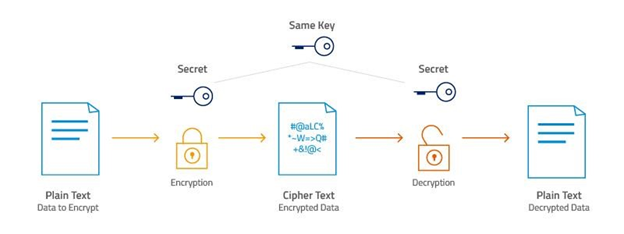 https://www.atpinc.com/blog/what-is-aes-256-encryption
The image shows how AES encryption works- the plain text is broken down into chunks of 128 bit data which is later encrypted into a ciphertext using a secret key and repeated and structural scrambling.
2. How Classical Data Transfer Systems Work
Electrical (Wired) Systems
Traditional systems like USB, HDMI, and Ethernet transport data using electrons. Data is sent through changes in voltage levels: a low voltage indicates a binary 0, while a high voltage denotes a binary 1. These systems are affordable, efficient, and reliable for short distances, but they are susceptible to electromagnetic interference and signal loss over long cables. Optical (Fiber) Systems Fiber optic systems utilize photons instead of electrons. Light pulses move through optical fibers, with the presence or absence of a photon representing 1 or 0. This method provides very high bandwidth and minimal loss, making it ideal for internet backbones and transcontinental communication. However, installation is costly, and maintenance is complicated.
Electromagnetic (Wireless) Systems
Wireless transmission, found in Wi-Fi, 5G, radio, and Bluetooth, conveys information using electromagnetic waves. The signal is modulated in one or more ways:
- Amplitude Modulation (AM): Data is encoded by varying the wave’s height.
- Frequency Modulation (FM): Data is encoded by changing the wave's oscillation speed.
- Phase Modulation (PM): Data is encoded in the timing of the wave; for example, a 180° phase shift could signify a binary 1. These techniques can provide tremendous flexibility in wireless communication, but they are also susceptible to interception and noise.
Ǫuadrature Amplitude Modulation (ǪAM)
QAM combines amplitude and phase modulation to increase the information density. For instance:
- 4-QAM provides 2 bits per symbol (00, 01, 10, and 11).
- 16-QAM represents 4 bits per symbol.
- 64-QAM represents 6 bits per symbol. The higher the QAM order, the greater the data rate, but this also leads to a higher error rate since the symbols become harder to tell apart.
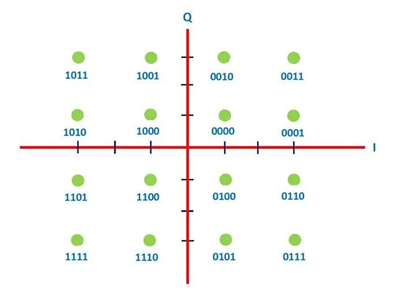
https://www.electrical4u.com/quadrature-amplitude-modulation-qam/#google_vignette
The image shows the constellation diagram of a 16-QAM
These classical systems transmit large volumes of data, yet they all share a common flaw—security. Classical bits can be copied, intercepted, or altered without detection.
3. The Shift to Quantum Communication
In quantum communication, the traditional concept of a classical bit—limited to 0 or 1—is replaced by the quantum bit (qubit). A qubit can exist in multiple states at once due to superposition. Instead of sending voltage levels or light pulses, quantum systems transmit quantum states of particles, usually the polarization states of photons or the spin states of electrons. A qubit may be in one of the following states:
- |0 (horizontal polarization),
- |1 (vertical polarization),
- or any superposition of both states.
The important concept is measurement collapse. Once a previously superpositioned quantum state has been measured, it loses its superposition and "collapses" to be either |0 or |1 . This allows for an undetectable interruption since there is nothing an eavesdropper can do to measure the qubits without changing the state of those qubits.
4. How Quantum Communication Systems Function
Quantum communication uses the uncertainty principle and entanglement to ensure the integrity of the data. The BB84 protocol conceived by Charles Bennett and Gilles Brassard is one of the simplest, yet important, protocols.
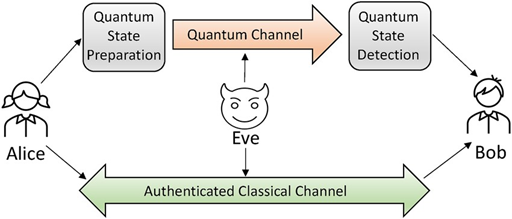
https://www.researchgate.net/figure/Schematic-of-a-general-quantum-key-distribution-QKDprotocol_fig1_361443234
{In cryptographic literature, the sender and receiver are typically represented by “Alice” and “Bob,” while an eavesdropper is referred to as “Eve.” These symbolic names simplify explanation and have no real-world correspondence.}
This is what happens when BB84 is implemented:
1. Transmission:
Alice can now send polarized photons at random angles (0, 45, 90, and 135). Each of these polarizations represents a bit.
2. Measurement:
Bob measures the photons using one of the bases he creates at random (rectilinear or diagonal). If Bob measures a photon using the same basis that Alice used to send it, he records the correct bit. Otherwise, if two photons are distinguished according to another basis, then it will be random noise.
3. Public discussion:
Alice and Bob will discuss which bases they used in the secure channel. The actual bit values they don’t discuss now. They both will retain the bits where the bases were the same.
4. Error checking:
If they see too many errors, they will know that someone (Eve) has been intercepting the conversation since measurement disturbs quantum pathways.
5. Key generation:
The bits with which they both agree can now be used as a someday code for a perfectly secure encryption. They can be sure it will be safe, since measurement itself will change the data, so it would be easy to detect eavesdropping. This is a ground-breaking aspect that classical systems simply do not have.
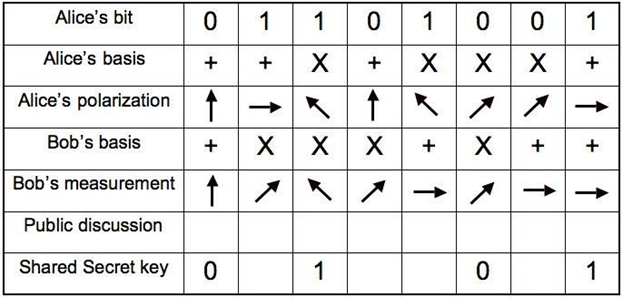
https://www.cse.wustl.edu/~jain/cse571-07/ftp/quantum/
Here, as we can see, the shared secret key is revealed only when the basis are same among Alice and Bob
5. Real-World Implementation
Quantum communication is no longer just a theory. Real systems already exist, and they are built from a few key components-
- First, there are sources and detectors of photons. Lasers are used to generate single photons, while highly sensitive detectors such as avalanche photodiodes catch them at the receiving end.
- Next, these photons need a path to travel, which can be provided by optical fibers or even free space. Fiber-based links work well over shorter distances, while free-space communication becomes useful when fibers are impractical, such as between buildings or across large geographic regions.
- Quantum states are fragile and cannot be amplified like classical signals. To deal with this, quantum repeaters are used. Instead of copying the signal, which would destroy it, repeaters help extend the communication link while preserving the quantum state.
- Space-based quantum communication avoids many of the losses that occur in optical fibers. A major milestone was achieved in 2016 when China’s Micius satellite successfully demonstrated quantum key distribution over a distance of about 1,200 km, proving that global-scale quantum communication is not science fiction anymore. Global investment in national quantum missions is being led by the US, China and India, as these countries build quantum secure networks and quantum internets.
6. Challenges and Limitations
For all its promise, quantum communication comes with some very real headaches.
- The first major issue is photon loss and decoherence, especially over long optical fibers. Quantum states are delicate, and the farther they travel, the more likely they are to get disturbed or disappear entirely. Unlike classical signals, you cannot just boost the signal.
- Many quantum detectors require cryogenic cooling to function properly, which means operating at extremely low temperatures. This is not exactly convenient, especially if you want widespread deployment outside controlled lab environments
- Quantum communication equipment is expensive, from photon sources to detectors and supporting infrastructure. This makes large-scale implementation difficult and keeps the technology out of reach for everyday use, at least for now.
- On top of that, there is limited standardization. Different systems often do not talk to each other well, and global interoperability is still a work in progress. Building a quantum network is hard enough without every country and lab speaking a slightly different hardware language. Even with these limitations, things are moving forward steadily, and developments and rapid advancements in photonics and quantum error correction are bridging the gap.
7. Looking Ahead
The future objective is the creation of a Quantum Internet, a global interconnected network of quantum devices that can facilitate:
- Communication that is absolutely secure.
- Distributed quantum computing.
- Quantum cloud networks that can share entangled qubits across continents. Combining this with 6G networks and AI-based error correction will make quantum communication scalable and practical.
8. Conclusion
Quantum communication redefines security at a fundamental level. Instead of relying on algorithms, we depend on the laws of the universe. From the BB84 protocol to satellite-based QKD, the field has developed from a theoretical concept to a functional reality.
As this technology keeps improving, we are heading toward a future where eavesdropping is not just difficult but physically impossible. Any attempt to listen in leaves fingerprints behind. In short, quantum communication does not just protect data better, it makes the universe itself a very bad place to be a hacker.
References
-
C. H. Bennett and G. Brassard, “Quantum Cryptography: Public Key Distribution and Coin Tossing,” Proceedings of IEEE International Conference on Computers, Systems and Signal Processing, Bangalore, India, 1984, pp. 175–179. doi:10.1109/ICCSSP.1984.231806
-
S. Wehner, D. Elkouss and R. Hanson, “The Quantum Internet: Networking Quantum Processors,” Science, vol. 362, no. 6412, 2018, pp. eaam9288. doi:10.1126/science.aam9288
-
F. Arute et al., “Quantum Supremacy Using a Programmable Superconducting Processor,” Nature, vol. 574, pp. 505–510, 2019. doi:10.1038/s41586-019-1666-5
-
National Quantum Mission, Ministry of Science & Technology, Government of India, 2023, https://dst.gov.in/national-quantum-mission-nqm
-
Cover picture- https://postquantum.com/post-quantum/quantum-key-distribution-qkd-cyber/